
For crane and forklift operations Malaysia projects, a crane is normally considered when a load must be suspended, lifted over an obstruction or placed beyond ground-level reach, while a forklift is often considered for supported movement where the load, route and handling arrangement suit the machine. The correct choice depends on verified weight, dimensions, centre of gravity, handling points, access, surface conditions and final position—not the equipment name alone.
Start with the movement, not the available machine
The first question should not be “Which machine is available?” It should be “What movement must the load complete?” A piece of machinery may need to be lifted from a trailer, transferred through a doorway, turned inside a factory, lowered onto a foundation or positioned within a narrow production line. One machine may not suit every stage.
For an initial review in Malaysia, describe the movement from the starting position to the final position. Include where the load is supported, when it must become suspended, the required height or reach and any change of direction. This helps separate a simple handling task from a movement that may need coordinated crane and forklift operations.
When a crane may be the closer fit
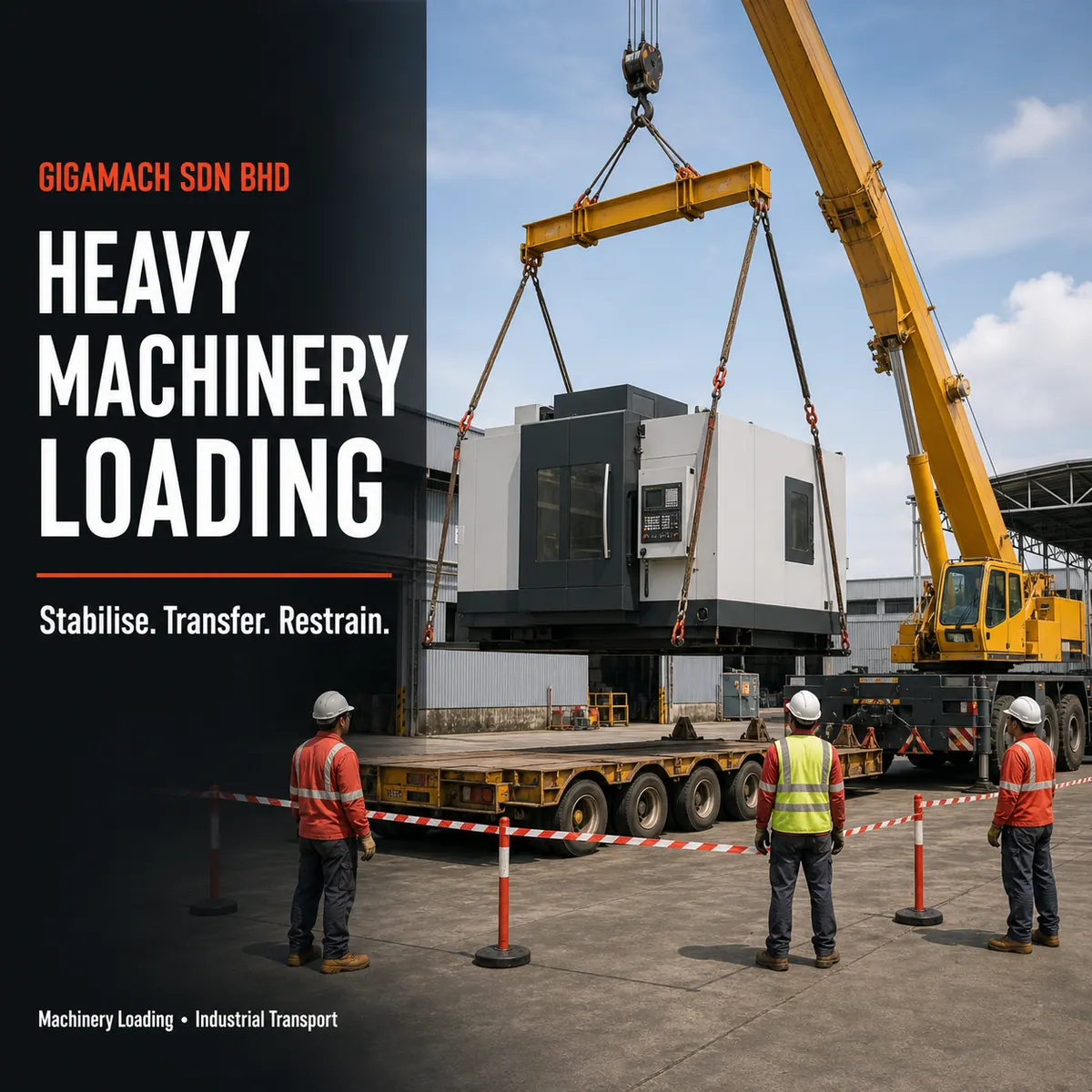
A crane may be considered when the machinery must be lifted clear of the ground, placed over an obstruction, handled from above or positioned where suitable forklift access is unavailable. The review should include the required reach, lifting height, setup area, supporting ground, overhead restrictions and the load’s approved handling points.
The crane also needs a practical path for the suspended load. Check nearby structures, operating equipment, services and areas used by other people. The lifting method, rigging arrangement and communication plan should be prepared for the verified load and site rather than copied from a different job.
Where the task primarily involves a suspended lift and controlled rigging, the heavy lifting and rigging service provides useful related context.
When a forklift may be the closer fit
A forklift may be considered for supported movement, loading, unloading or short-distance positioning when the route, surface, clearances and load arrangement are suitable. The review should identify how the load will be supported, where the forks or approved attachment will engage and whether the centre of gravity remains compatible with the proposed configuration.
Do not treat a forklift’s stated capacity as permission to lift every load below one number. The actual load position, attachment, fork spacing, lifting height and machine configuration matter. Check the equipment information and handling arrangement for the specific task. Improvised contact points or an unverified centre of gravity can change how the load behaves.
Forklift travel also requires enough width, turning space, overhead clearance and surface support along the full route. Doorways, ramps, floor transitions, drains and pedestrian crossings should be recorded before mobilisation.
When a combined method may be needed
Some movements have separate lifting and positioning stages. A crane might remove machinery from a vehicle or lift it across an obstruction, while a forklift or another suitable handling system supports a later transfer or final approach. This is not automatically safer or more efficient; each handover introduces a new load condition that must be planned.
Define where the transfer happens, how the load is supported before rigging is released and who controls the sequence. The receiving equipment and team should be ready before the movement begins. Nobody should improvise a different transfer point because the intended area is blocked or unavailable.
Seven facts that guide the decision
- Verified load information: weight, dimensions, centre of gravity and any removable or sensitive components.
- Handling points: approved lifting points, fork pockets, base frame or other manufacturer-provided information.
- Required movement: lift height, reach, travel distance, direction changes and final orientation.
- Access and setup: delivery route, machine width, turning area, crane setup space and overhead clearance.
- Supporting conditions: ground or floor condition, slopes, covers, edges and known restrictions.
- Work-area controls: nearby production, pedestrians, vehicles, exclusion area and communication method.
- Final position: foundation height, alignment requirement, surrounding clearances and how handling equipment will be removed.
Information to send with an initial enquiry
- Machinery name, available drawings and verified weight
- Overall dimensions and marked centre of gravity, if known
- Photographs of the machine, base and handling points
- Photographs and dimensions of the route and work area
- Starting position, required final position and orientation
- Required date and site operating restrictions
- Whether loading, unloading, internal transfer or final positioning is included
GIGAMACH SDN BHD can use this information for an initial discussion of the crane and forklift machinery-handling requirement. Where the work begins or ends at a vehicle, the machinery loading and unloading service may also help clarify the wider scope.
Frequently asked questions
Can the method be selected from a photograph?
A photograph can reveal access and handling clues, but it does not verify weight, centre of gravity, floor support or the complete route. Measurements and reliable load information are still needed.
Is a forklift always quicker for a short movement?
Not necessarily. A short distance can still involve tight clearances, unsuitable surfaces or a load arrangement that does not match the forklift. Method selection should follow the verified movement and conditions.
What if the final position is inside a narrow production area?
Provide route dimensions, turning space, overhead clearance and photographs of the final approach. The plan may need more than one handling stage or a different positioning system after the initial lift.