
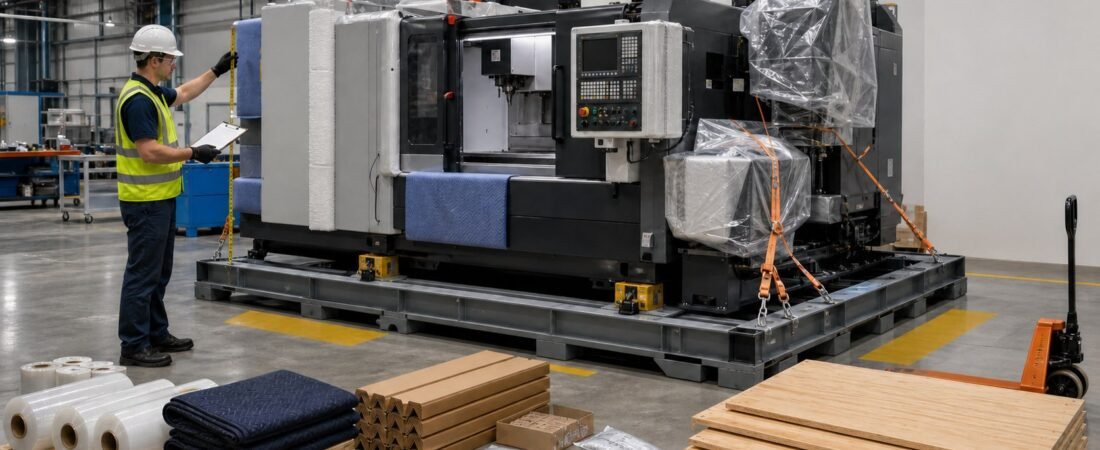
Before industrial machinery is packed and crated, confirm the machine identity, overall dimensions, verified weight, centre of gravity, lifting or forklift access, sensitive components, transport route, destination conditions and storage duration. These details determine how the equipment should be supported, protected, handled and marked. A crate built without them may protect the outside while leaving the machine vulnerable to movement, moisture, impact or unsafe handling.
This industrial machinery packing checklist helps plant teams prepare useful information before requesting a packing method or quotation. It is a planning guide, not a substitute for inspecting the actual machine and route.
1. Identify exactly what is being packed
Start with the equipment name, model, serial number and a clear description of its current condition. Record whether the package will contain one complete machine, a base unit with removed parts, or several separate assemblies. This avoids confusion when panels, guards, tooling and accessories are packed in different cases.
Useful information includes:
- equipment name, model and asset reference;
- overall length, width and height in its transport configuration;
- verified total weight and the weight of major separated components;
- existing lifting points, forklift pockets and base-frame details; and
- recent photographs from all sides, including the underside where accessible.
Do not estimate critical weights or handling points from appearance alone. If verified information is unavailable, flag that uncertainty early so it can be resolved before packing begins.
2. Confirm the transport configuration
A machine may be safe in its operating position but unsuitable for transport in the same configuration. Confirm which items will be removed, lowered, locked or supported. Doors, slides, arms, cable carriers, control panels and loose tooling should not be allowed to move freely inside a closed package.
Prepare a simple dismantling and reassembly record. Photograph connection points before disconnection, label mating parts consistently and keep small fasteners in identified bags or containers. Where a specialist must isolate utilities or secure an internal axis, record who will perform the work and when it will be completed.
3. Mark sensitive and restricted areas
Tell the packing team what must not carry load or receive direct contact. Sensitive areas may include machine covers, glass panels, touchscreens, linear scales, spindle assemblies, exposed connectors, precision surfaces and protruding sensors. Clearly identify any area where straps, blocking or forklift tines must not be placed.
Also confirm whether the equipment contains residual fluids, batteries, pressurised components, delicate calibration items or other parts requiring separate preparation. The correct response depends on the machine, transport mode and destination requirements; it should not be assumed from a generic checklist.
4. Describe the full journey, not only the crate
The packing method should suit the handling sequence. A package moved once by forklift inside a factory faces different conditions from one that will be lifted, loaded, transported, stored and unloaded several times.
Provide the planned transport mode, estimated journey duration, expected storage period, indoor or outdoor exposure, number of handling transfers and destination access conditions. Confirm door sizes, loading-bay limits, container or vehicle interfaces and any height or weight restrictions along the route.
If the same team is coordinating the Packing & Crating scope before the crate is closed. Also coordinate the destination unloading plan and handling sequence before closure. Handling access, package stability and transport restraint need to work together.
5. Agree how the packed machine will be handled
A crate should not hide the information needed for safe handling. Confirm the intended lifting and forklift method, the required clearance below the base, the package orientation and the points that must remain accessible. If lifting lugs or forklift entries will be used, they must relate to the supported load and the final packed weight.
Plan visible package markings for orientation, centre of gravity, gross weight, handling points and fragile or keep-dry instructions where they genuinely apply. Markings should match the finished package, not an earlier estimate.
6. Prepare a packing handover record
Before closure, make a short record that another team can understand at the destination. It should identify what is inside each package, what has been removed, where accessories are stored and what must happen before the machine is lifted out or reassembled.
A practical handover pack may contain:
- a package list and crate identification numbers;
- before-packing photographs and closure photographs;
- dimensions and confirmed gross weight for each package;
- a list of removed parts, accessories and fasteners;
- handling and orientation information; and
- contact details for technical questions at origin and destination.
Information to send with an initial enquiry
For an initial discussion, send the equipment type, dimensions, verified weight, pickup and destination details, transport date, storage expectation and clear photographs. Mention any known sensitive surfaces, restricted handling areas and dismantling requirements.
GIGAMACH SDN BHD provides industrial packing and crating services that can be coordinated with machinery handling and transport requirements. Final materials, supports and crate construction should be confirmed from the verified equipment information and actual handling plan.
Frequently asked questions
Can a packing method be confirmed from photographs alone?
Photographs are helpful for an initial review, but they may not confirm the weight, centre of gravity, base strength, sensitive internal parts or route restrictions. Additional equipment documents or a site inspection may be needed before the final method is agreed.
Should the crate be designed before dismantling is complete?
Preliminary dimensions can be used for planning, but the finished crate should be based on the confirmed transport configuration. Removed components, protective clearances, supports and handling access can all change the final package size and weight.
Why coordinate packing with loading and transport?
Because the package must remain stable and accessible throughout the whole journey. Early coordination reduces the risk of discovering that a finished crate blocks the planned lifting method, exceeds a route limit or cannot be restrained as intended.