
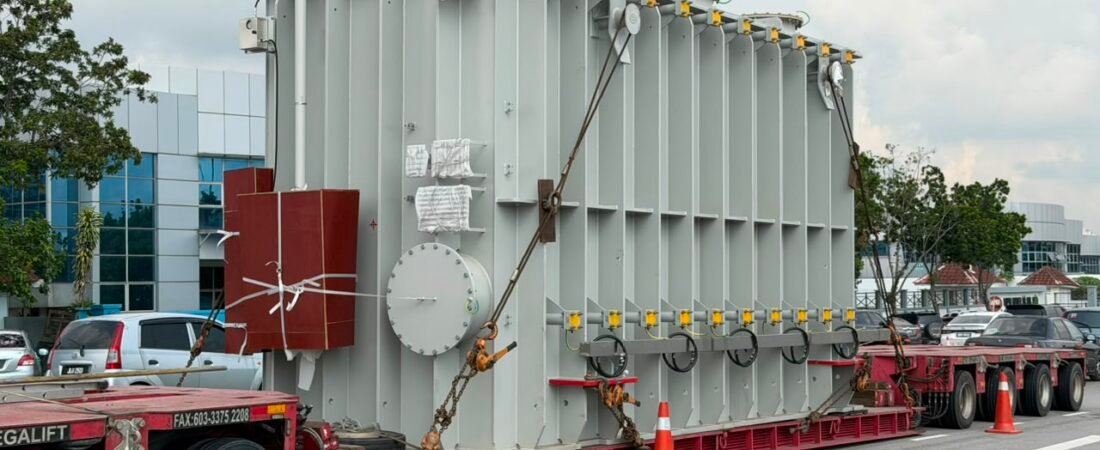
Before industrial machinery transport, verify the machine’s transported-state length, width and height, plus its confirmed weight, support footprint, low points, handling points and any packing or skid additions. Record the source and date of each value, then remeasure after dismantling or packing because the transport envelope may differ from the machine’s operating dimensions.
Start with the transported state, not the catalogue size
A catalogue drawing often describes a machine in its operating configuration. Transport may require covers, guards, platforms, cables, ducts, tanks or other detachable items to be removed. A skid, crate, wrapping, corner protection or temporary support may then add new dimensions. The useful number for planning is therefore the final transport envelope: the complete space occupied by the machine and everything that will travel with it.
Define that configuration first. Mark which parts remain attached, which are removed, how loose components will be packed and whether temporary supports will be installed. Without this step, different people can report accurate measurements for different versions of the same machine.
What machinery dimensions and records should be verified?
1. Overall length, width and height
Measure the maximum points of the transported configuration, not only the main frame. Include projections such as handles, brackets, motors, pipe stubs, control panels and protective packing. Note whether the figure is measured, taken from an approved drawing or still awaiting confirmation.
2. Base and support footprint
Record the length and width of the actual supporting base, skid or machine feet. Also identify low-clearance areas beneath the machine. These details help the handling team understand where support may be possible and where forks, skates, beams or temporary packing must not make contact. They do not, by themselves, confirm a handling method.
3. Weight and its source
State the weight together with its source: for example, a current equipment drawing, nameplate, manufacturer record or other verified document. Separate the machine weight from the weight of skids, crates, loose parts or accessories. If the value is estimated or uncertain, label it clearly rather than presenting it as verified.
4. Centre-of-gravity and handling information
Include centre-of-gravity information, lifting points and approved handling points when reliable documentation is available. Do not guess these positions from appearance. An unusual internal mass distribution can make a symmetrical machine behave unevenly during lifting or transfer, so unknown information should be raised for review.
5. Packing, skid and loose-part additions
List every item that changes the final envelope or weight: timber or steel skids, crate panels, moisture barriers, external brackets, removed assemblies and separate accessory packages. Give each loose package its own identification, dimensions and weight where available so it is not confused with the main machine.
Measure the interfaces, not only the machine
A complete machine data sheet should be compared with the points it must pass through. At the collection site, check the exit opening, corners, gradients, floor transitions and loading position. At the receiving site, check the unloading position, transfer route, final opening and placement area. Record clear dimensions and photographs from useful angles.
Do not treat a single narrow width as the whole route assessment. Turning space, height changes, overhead obstructions, surface conditions and the position of the machine on its support can all affect the available clearance. Vehicle and handling-equipment selection should follow a review of the verified load and both sites.
Build one controlled transport data sheet
Keep the information in one controlled record instead of several chat messages or unlabelled photographs. A practical sheet can include:
- machine identification and asset reference;
- transported-state length, width and height;
- verified weight, value source and document reference;
- base footprint, ground clearance and sensitive low points;
- documented centre-of-gravity, lifting and handling information;
- removed parts, packing, skid and separate-package details;
- collection and delivery addresses and site contacts;
- dated photographs, annotated drawings and measurement owner;
- revision number and status for every unresolved item.
Use simple statuses such as Verified, Conditional and Unknown. This makes open questions visible before collection arrangements are finalised. When a measurement changes, update the revision and retain the previous value so the team can see what was changed and why.
Remeasure after dismantling and packing
The best time for a final check is when the machine is in the same state in which it will travel. Confirm the maximum envelope, support arrangement, separate packages and identification labels after dismantling or packing. Compare the result with access and receiving information. A change to the skid, crate or attached parts may require the transport and handling plan to be reviewed again.
When should planning pause for clarification?
Hold the transport review when a critical value is missing, conflicting or based only on assumption. Typical examples are an unverified weight, unclear lifting points, packaging that is not yet designed, an access opening with no confirmed clear width or a destination that has not prepared its unloading area. Resolving these gaps early is safer and more efficient than discovering them when the vehicle or handling team is already on site.
Frequently asked questions
Are manufacturer dimensions enough for transport planning?
They are a useful reference, but they may describe the operating machine rather than its transported state. Field verification is still needed when parts are removed, packing is added or the documented configuration does not match the actual equipment.
Should packing and skid dimensions be included?
Yes. Record the final external dimensions and added weight of the complete transport package, while keeping the original machine data separately identifiable.
What photographs are useful for an initial transport review?
Provide full views of every side, the base and support points, identification plates, handling points, origin exit, loading area, destination unloading area and the intended transfer route. Label photographs so the location and viewing direction are clear.
Discuss industrial machinery transport in Malaysia
For an initial review, send GIGAMACH SDN BHD the machine data, available drawings, site photographs, collection and delivery locations and required dates. Learn more about our industrial transportation service in Malaysia, browse the Gigamach Insights library, or contact the team to discuss the scope.